
What Is Clubfoot Correction?
Clubfoot is one of the most common forms of congenital disability affecting the muscles and bones within the foot. In clubfoot, the foot points downward and twists inward, tending to lie straight down instead of upward. This twists the toes toward the opposite leg. The baby could be born with this defect in either one or both feet.
Clubfoot is not painful. However, it does pose a health issue when a child starts standing and walking. Clubfoot that remains untreated can cause severe disabilities and even render the child unable to walk. So, it is crucial to begin correcting it early, ideally within a week or two of birth.
Why is the procedure performed?
A baby born with clubfoot is treated first by casting the foot out to a more normal position.
A new cast is applied each week to stretch the foot.
Cast changes are performed for approximately two months. The child will wear a brace for many years if done by casting.
Clubfoot in babies can generally be addressed with casting and bracing to avoid surgery.
However, surgical repair of the clubfoot may be necessary if:
- The cast or some other treatments are not adequate in fixing the deformity.
- The defect relapses.
- A clubfoot was never treated.
What is the Purpose of Clubfoot Treatment?
When children have flat feet, the condition often outgrows into a normal developmental phase. If the development of flatfoot progresses into adulthood or becomes problematic in later years, surgery can usually correct the curve of the arch of the foot.
The objective of this kind of surgery is to allow a return of the natural angle to the foot. This allows the patient to walk, stand, or participate in any desired activity without discomfort and instability.
This objective is typically achieved with a patient-tailored mix of procedures that could involve bone osteotomies and disruption of tendons and ligaments under arches.
How early in a child's life can this baby start with the Ponseti Method?
A baby born with clubfoot should be treated by an experienced pediatric orthopaedic surgeon in manipulation and Ponseti method as soon as the diagnosis is confirmed. Ideally, treatment of congenital clubfoot should start immediately after birth. However, as we know in the present day, it has been demonstrated that this method can be very effective even if treatment was begun many months after.
What are some other non-surgical methods used for clubfoot correction?
There are many treatment options for clubfoot. Many providers prefer to use soft fiberglass casting material rather than the plaster used in the Ponseti method. The parent can remove the cast before each visit weekly in the orthopaedic clinic. The manipulation and casting are continued until the deformity is either corrected or the degree of correction plateaus.
What is the surgical treatment of clubfoot correction?
Surgical intervention is indicated if manipulation/serial casting fails to work. Primarily, the surgery is performed when the child is around six to nine months of age. Surgery corrects clubfoot and properly aligns the foot in a near-normal position. The standard surgical treatment usually adopted involves stretching and lengthening the foot's tight tendons/joint capsule. Some surgeons prefer to make two incisions, one posteromedial and a smaller lateral, to allow better mobilization of the upper extremity and better exposure. Alternatively, a single circumferential incision may be performed. The surgery is usually around 2-3 hours, and one or two days in the hospital is generally adequate.
Corrections are typically held in place with small pins inserted into the bones, which are removed in the office around 4-6 weeks following surgery. Apart from this, after surgery, it will be subjected to casting for six to twelve weeks, at which time the foot will have been placed in a long leg bent knee cast. Casting may then be followed by the use of a brace, full-time or at night, for an additional period.
Two classes of surgical treatment:
- Soft tissue releases allow the tight tendons/ligaments around the joints to be released, causing the tendons to lengthen. Approximately 30-50% of all patients treated for clubfoot will need this (often heel cord lengthening with tibialis tendon transfer). Tendon transfers improve the position of the tendons/ligaments.
- Bony procedures such as osteotomies/arthrodeses divide bone or surgically stabilize joints, enabling the bones to grow solidly together.
What are the risk factors for clubfoot?
Family History:
- Family history of clubfoot
- Smoking during pregnancy
- Male gender
What happens before the operation?
Your child's health care provider will likely:
- Obtain a medical history of your child
- Do a thorough physical examination of your child
- Do x-rays of the clubfoot
- Test your child's blood (do a complete blood count and check electrolytes or clotting factors)
Always tell the doctor who will be caring for your child:
- What medicines your child is taking.
- Include herbs and vitamins you purchased without a prescription
In the days leading up to the surgery:
- You will likely be told to discontinue administering aspirin, ibuprofen (Advil, Motrin), or any other blood-thinning medication around 10 days before the operation.
- You will ask if the medications your child should continue taking on the day of surgery.
The day of surgery:
- In general, for 4 to 6 hours before surgery, your child can't eat or drink anything.
- Administer only minimal quantities of water with any medication your doctor has prescribed that you give to your child.
- The schedule will inform you of the date on which to report for the surgery.
What to expect following the procedure?
Depending on the surgery, your child may go home on the same day or stay in the hospital for 1 to 3 days after the surgery. If the surgery is on the bones, then the period of stay in the hospital may be prolonged.
The foot of a child should be elevated. The doctor may also prescribe several medicines to help relieve the pain.
The skin around their cast will be checked regularly to remain pink and healthy. Your child's toes will also be checked to see if they are pink, and your child can wiggle and feel them. These are indications that the blood flow is adequate.
The cast usually stays for 6 to 12 weeks and may be changed several times. Before your child leaves the hospital, you'll be shown how to care for the cast.
When the final cast is finally removed, your child will probably be fitted with a brace and possibly sent for physical therapy. The therapist then instructs you on exercises you can do with your child to strengthen the foot and keep it loose.
How long is my child likely to be under the care of an orthopedic surgeon?
Children will need follow-up for several years after casting or surgery to monitor for recurrent clubfoot. Most commonly, recurrence is observed a year or two after treatment but can recur many months after casting or surgery. Recurrent clubfoot can be treated with manipulation/casting or further surgery. We, therefore, tend to follow up until the completion of growth, roughly when they are about 18 years old.
Why Tender Palm Super-Speciality Hospital for Clubfoot Correction?
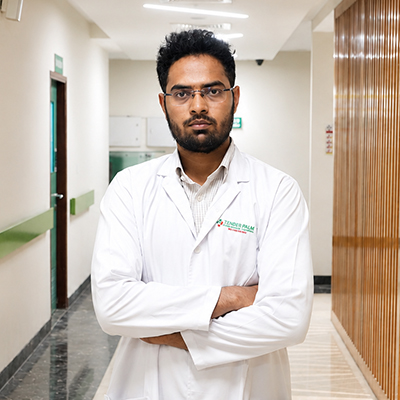
Tender Palm Hospital, owned by doctors, is renowned for attracting the most skilled professionals in the country. With the finest Orthopedic surgeons, specialized in Clubfoot Correction. Tender Palm stands out as the premier orthopedic hospital in Lucknow, India. Boasting cutting-edge infrastructure and advanced technology, Tender Palm ensures top-notch medical care for its patients.
To seek an expert consultation for any orthopedic condition.
Call us at +91-9076972161
Email at care@tenderpalm.com
Our Experts



Awards & Accreditations


